Message sent on
House / Villa
8 Rooms
•
360 m²
Mairie-Albine, Saint-Paul-lès-Dax
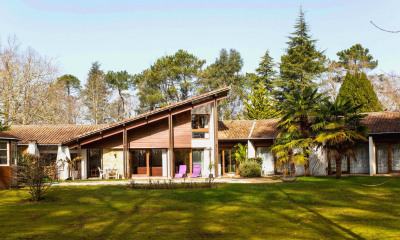
Just 20 minutes from the Landes beaches, this property sits at the heart of a 1.6-hectare listed park, in a peaceful and perfectly preserved setting. Offering approximately 360 sq m of living space, the house features generous open-plan living areas that flow seamlessly onto the outdoors, extending onto spacious terraces and a garden structured around a swimming pool. The interior layout prioritizes fluid circulation and a balanced distribution between the reception areas and the sleeping quarters, comprising five bedrooms and five bathrooms. Secluded and private, yet close to amenities, the property offers a rare living environment, blending nature and comfort. Designed in 1977 by architect René Guichemerre, the house's design is inspired by Frank Lloyd Wright's "Prairie Houses," adapted to the Landes landscape. Its low, elongated silhouette, overhanging roofs, and expansive glazed facades create a strong horizontal presence, in direct dialogue with the garden. The house is organized around a more vertical central volume housing the living area. This heart of the home, characterized by its high ceilings and split levels, structures the spaces and offers varied perspectives. The design prioritizes open floor plans and fluid circulation, where each room maintains a direct connection with the outdoors. Wood, stone, brick, glass, and enamels compose a palette of materials that are both simple and expressive, characteristic of 1970s architecture, in a quest for balance between modernity and regional roots. Commissioned by Jean Labeyrie in the late 1970s, this house arose from the desire to create a living space in harmony with its surroundings. Guichemerre approached the project as a landscape to be composed: a setback placement, preservation of dense vegetation around the perimeter, and opening up the site at its center to capture light. Influenced by the American architecture of Neutra and Wright, while incorporating vernacular elements of the Landes region, the house exemplifies a critical regionalist current specific to this period. Conceived as an ideal holiday home, it prioritizes a free and organic lifestyle, where the interior flows naturally into the garden. Even today, it retains this unique identity, at once discreet, open, and deeply rooted in its landscape.
 We recommend you change your browser for optimal navigation