Message sent on
Traditional property
7 Rooms
•
550 m²
Saint-Girons
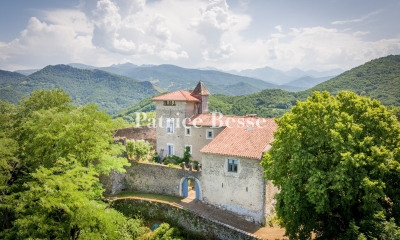
A 12th-century chateau with ramparts and 15 hectares of grounds, listed as a historical monument and looking down over a valley by the Pyrenees mountains. From a bird's-eye view, the chateau seems to be perched atop a wooded hill like a sentry looking out across the undulating landscape of France's Couserans province. Around the chateau, there is a patchwork of gently sloping meadows, woods and fields that lines the serrated horizon of the Pyrenees mountains. Your gaze, first struck by the relief of the land, is eventually drawn to the oval form of the chateau's enclosing wall that encircles a plain mass of barrel-tiled roofs and pale stone elevations. All aspects of this chateau give the impression of a calm, dense, unshakeable unit. As you leave the local village to approach the chateau, the modern world fades away. The road becomes a country lane and later becomes a shady track. The driveway to the chateau is flanked with oaks and beeches and edged with stone bollards crowned with orbs and linked with a chain. This driveway seems like a formal route, rigorously plotted and solemnly discreet. There is no showy gate here, but just the murmur of the wind, sunrays filtered through leaves and a rare feeling of slowly ascending to a dwelling inhabited by something other than everyday life. At last, the chateau's facade comes into view between the trees. Plain yet welcoming, the chateau adjoins its rampart like a hand fitting into a glove. A door in an arch that cuts through the full thickness of the enclosing wall marks the entrance. Beyond this archway, you find yourself in an inner court, some of which is grassy. Here you can see different tokens of the chateau's past: a well dug into the rock, the Romantic ruins of outhouses waiting to be brought back to life, a square tower, adjoining annexes and successive recesses of architecture that has adapted over time without ever betraying its origin. The chateau was built in the 12th century. In the 17th century, it was turned into a summer holiday home. Today it is listed as a historical monument. The chateau has kept its structural coherence and residential design.
 We recommend you change your browser for optimal navigation